
Sol at $440. Grok at $128. Saving $312. I checked the first model's three lines on paper, then read the same three lines from the second model, then from the third. Nobody rounded. Nobody dropped a line. I had expected the arithmetic to go wrong somewhere, because arithmetic in a chatbot usually goes wrong somewhere, and it was the one part of the afternoon I could grade without a rubric.
The afternoon started with a colleague asking me, without irony, which model was winning. Grok 4.6 had just launched. GPT-5.6 Sol had been the coding default for a month. Anthropic was selling two flagships at once: Claude Fable 5, the expensive one, and Claude Opus 5, the one they want you to use every day. Every table looked like a race, so someone was supposed to be ahead.
So I read the public boards dated 12 to 15 August 2026: Artificial Analysis, Anthropic's Opus 5 post, xAI's Grok 4.6 launch table as checked by Digital Applied, and the VentureBeat write-up of the Grok launch. Then I gave Grok 4.6, GPT-5.6 Sol, and Claude Opus 5 the same two jobs: explain to a non-specialist whether a two-point index gap is a reason to switch, and compute a month of token cost from a fixed volume. Claude Fable 5 was not in my harness, so every Fable number below is someone else's measurement, labelled as such. I am not ranking models for all time, I did not run a coding agent, a terminal benchmark or a private LMSYS, and Grok's brand history, which is a real input for some buyers, gets a section here and not a review.
I used to treat "ahead on the index" as a good enough default for a regular user. I stopped this month, at least at a gap this small. The numbers disagreeing with each other did not surprise me. The honest ones still not being a reason to switch tools this week did.
Opus 5 by default, Grok 4.6 for the bill, Sol for terminals
Here is the decision, if you want it before the evidence. The job is choosing a default model for everyday knowledge work this month without becoming a benchmark analyst. On the boards dated 12 to 15 August 2026, Claude Opus 5 leads the independent index at half the token price of Claude Fable 5, and xAI's launch table for Grok 4.6 is accurate in every cell while leaving Opus 5 out of the picture. On my two jobs, Grok 4.6, GPT-5.6 Sol, and Opus 5 all said do not switch, and all three got $312. So: split. Opus 5 for daily work, Grok 4.6 when the bill is the constraint, Sol for long terminal and repo agents, Fable 5 only when you can name the gap it closes. None of that transfers to coding agents, long terminal jobs, or a regulated brand-safety review, which are different jobs graded on different boards.
Two points on a hundred-point blend
You already have a chatbot. You draft, summarise, analyse, and occasionally ask it to write code. Once a month a launch post tells you the old default is now losing, and the implied action is to switch today, because two points on a composite index look like a generation.
A composite index averages many tests into one number. Artificial Analysis's Intelligence Index is the one most of this month's coverage quotes. On the 15 August public snapshot it had Claude Opus 5 first at 63, Claude Fable 5 at 62, and Grok 4.6 around 61, with GPT-5.6 Sol in the same neighbourhood depending on the effort rung. Two points on a 100-point composite is inside the movement you get when the grader model changes or a lab posts a new effort tier.
The job, then, is what to type into on Monday and what would make you change your mind. Does a two-point gap show up in a brief you would actually send? On my two jobs it did not, and the middle of this piece is how I got to that answer.
Four checks before you quote a cell
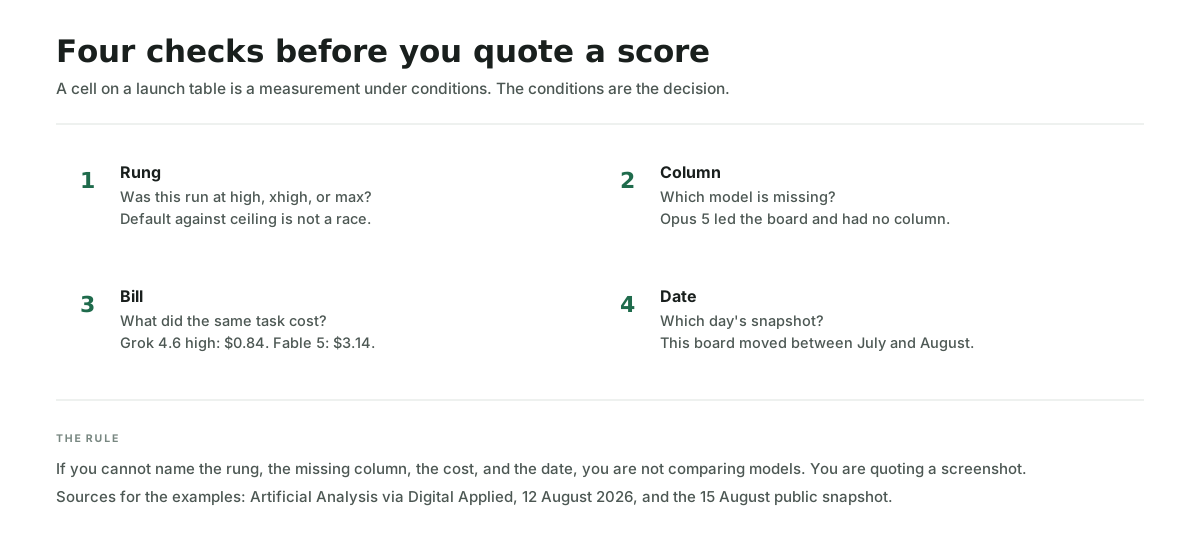
A high row printed against two max rows
Grok 4.6 has four documented reasoning rungs: low, medium, high, and xhigh, with high as the default and no max. GPT-5.6 Sol has six, ending at max. Claude Opus 5 and Fable 5 have five, also ending at max. Digital Applied's 12 August fact-check of xAI's launch table is the piece that made this load-bearing for me: xAI printed Grok 4.6 at high against Sol and Fable 5 at max. A default against two ceilings, which is a different thing from a race at the same effort.
I had assumed vendor tables inflate their own row. Here, to my surprise, the opposite happened, and it took me a second read of Digital Applied's table to believe it. On CursorBench v3.2, Grok 4.6 at Extra High is reported at 70.8%, above Fable 5 Max at 70.5%, and xAI printed its 69.9% High row instead. Accurate numbers, a conservative rung, still a framed comparison.
The board leader is missing from the table
The same xAI table has four columns: Grok 4.6 High, Grok 4.5 High, GPT-5.6 Sol Max, Claude Fable 5 Max. Claude Opus 5 is not in it. Digital Applied checked the eight independently verifiable rows and found Opus 5 leading seven of them, including Artificial Analysis's index at 63.05. Bold the best score per row inside a field that excludes the leader and an honest table points at the wrong default.
Grok finishes an index task for $0.84
Headline API rates as of the Grok 4.6 launch write-up: Grok 4.6 at $2 input and $6 output per million tokens under 200K, Claude Opus 5 at $5 and $25, GPT-5.6 Sol standard at $5 and $30, Claude Fable 5 at $10 and $50. Artificial Analysis's cost per Intelligence Index task is the more useful unit, because models spend different numbers of tokens to finish the same work. Digital Applied reports Grok 4.6 high at $0.84, Sol max at $1.23, Opus 5 max at $2.34, and Fable 5 with fallback at $3.14. Grok tying Sol on the index at a third of Fable's task cost is a real fact. It is a different fact from "Grok is more capable."
The 63 was a 61 in July
Artificial Analysis's own 24 July Opus 5 note had Opus 5 max at 61, tied with Fable 5 at 60, ahead of Sol max at 59. Between that note and the 15 August snapshot the index version changed and the grader models changed. The models did not. If your switching rule is "whoever is first today," you will switch more often than your work changes.
Opus 5 leads the index at half Fable's price
Reported
On Artificial Analysis's Intelligence Index, the 15 August public snapshot ranks Claude Opus 5 first at 63, Claude Fable 5 at 62, and Grok 4.6 at about 61. Digital Applied's 12 August table, using AA's own labels, has Opus 5 max at 63.05, Fable 5 with fallback at 62.07, GPT-5.6 Sol max at 60.93, and Grok 4.6 high at 60.92. The Sol and Grok high/max pair sit inside AA's stated plus-or-minus 1% interval.
Those four numbers are the headline, and they are the August end of the moving object from the section above.
Reported
On knowledge-work boards, Opus 5 is the model the independent write-ups keep handing the lead. Artificial Analysis reported Opus 5 max at 1861 Elo on GDPval-AA v2 and 1720 on AA-Briefcase at launch. VentureBeat, citing AA on the Grok launch, has Grok 4.6 at 1753 Elo on GDPval-AA v2, Fable 5 Max at 1741, and Sol Max at 1728. Those two snapshots are not the same run. They are the same story: knowledge work is not where Sol pulls away.
Reported
On software-agent boards, the lead moves. VentureBeat's Grok 4.6 table, transcribed from xAI and checked against public boards, has GPT-5.6 Sol Max at 73% on DeepSWE v1.1 and 34.6% on Terminal-Bench v3.0, Fable 5 Max at 70% and 34.1%, Grok 4.6 High at 65.9% and 26%. CursorBench v3.2 is the close one: Fable 5 Max 70.5%, Grok 4.6 High 69.9%. Anthropic's Opus 5 post says Opus 5 at max is within 0.5 points of Fable 5's CursorBench peak at half the cost per task.
I expected Fable 5 to own the independent index, because it is the expensive flagship and that is what expensive flagships are for. It does not, and I did not expect to be writing that sentence. Opus 5 does, on the August snapshot, at half Fable's token price. Anthropic has been trying to say this out loud since 24 July, and I had filed it under marketing until the independent boards agreed. My read is that "expensive flagship" has stopped being a useful proxy for "best on the independent board," at least this month.
Thirty-one of thirty-one cells check out
xAI's Grok 4.6 launch table is the cleanest example I have seen all month, because Digital Applied reproduced 31 of 31 publicly checkable cells and still ended up warning you not to route budget off the bolding.
The table does not invent scores. It selects them. Each cell is the best number available from a public board or a system card, produced under whatever harness that board used. Fable 5 still wins five of the ten rows xAI printed. Grok 4.6 wins three. Two of those three, on AA's own confidence intervals, sit inside the error bars. The model that leads the independent index is not in the picture.
xAI is not cheating here, and this is how almost every launch table works. This one is better than most because the footnote admits the cells were not run under one harness: "Third-party model scores are the best of self-reported or publicly available results." Once you can see that sentence, you can read the rest of the month the same way.
Inferred
A regular user who switches defaults because Grok 4.6 "beat" Fable 5 on xAI's table has not compared those two models at matched effort, and has not compared either of them to Opus 5 at all.
One explainer and one month of tokens
I wanted a test a regular reader would recognise as work, and I wanted at least one part of it I could grade on paper.
The question
If I give Grok 4.6, GPT-5.6 Sol, and Claude Opus 5 the same explainer and the same arithmetic, does the two-point index gap show up in a way I would notice without a rubric?
- Baseline
- All three give the same advice and the same numbers.
- Continue if
- One model is clearly better on the explainer, or one of them flubs the arithmetic.
- Stop if
- They agree on the advice and match on the math. The board did not show up in the work.
Task A: 160 to 200 words for a colleague who uses ChatGPT at work and does not follow AI news. If Opus 5 scores 63 and Grok 4.6 scores 61, should they switch this week? One concrete analogy. No em dash.
Task B: 40 million input tokens and 8 million output tokens. Sol at $5 / $30. Grok at $2 / $6. Cost on Sol, cost on Grok, saving. Three labelled lines, then stop.
I ran Grok 4.6 at high-fast, GPT-5.6 Sol at xhigh, and Claude Opus 5 at thinking-high, on 15 August 2026. Those are not matched rungs. I am doing the thing I spent a section criticising, in the only harness I had, and I would rather say so than hide it in a footnote. Fable 5 was not available, so it is absent on purpose. The prompts, the three outputs, and the arithmetic live in the prototype repository.
Going in, I expected Opus 5 to be the clearer explainer, Grok to be looser, and someone to drop a line of arithmetic. I also expected the index gap to be faintly visible in the prose, the way a 63 and a 61 on a hiring screen are faintly visible in an interview. I wrote that down before running anything, which is the only reason I can tell you how wrong it was.
Two hiring analogies and a company car
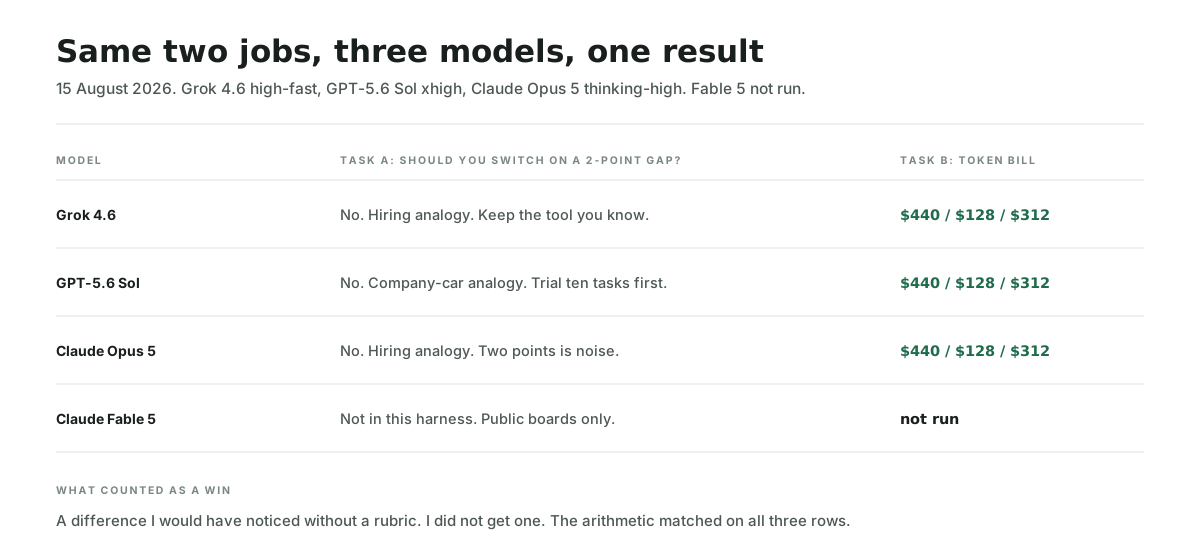
Reproduced
All three models advised against switching on a two-point composite gap. Grok and Opus reached for a hiring analogy. Sol reached for a company car. All three computed Sol at $440, Grok at $128, and a saving of $312. None flubbed the arithmetic.
The stop threshold fired. From these two jobs, I could not have told you which model led the index.
I had assumed "best on the board" would show up straight away in ordinary prose, and that assumption is what the verdict below is built on the ruins of. On this pair of jobs it did not show up at all. The smaller and more irritating surprise was the money. I was sure I would catch at least one model rounding it, and I had half-written the paragraph about which one. Nobody did. The $312 saving is the only number from the trial I trust as a fact, because I can redo it on paper, and it is the number three models handed me identically.
Unknown
I am not sure whether a coding agent, a long terminal session, or a messy internal document would have separated them. I did not run those. The public boards suggest they might. My two jobs do not.
Where the 63 stops meaning anything
The index averages jobs you do not do
GDPval and AA-Briefcase look like knowledge work. Terminal-Bench and DeepSWE look like agents in a repo. CursorBench looks like in-editor coding. Averaging them produces a 63 and a 61 that can reverse on the one job you actually pay for. If your week is briefs and analysis, Opus 5's knowledge-work lead is the relevant column. If your week is a long autonomous terminal job, Sol's DeepSWE and Terminal-Bench rows are. Pick either from the blend and you have bought the wrong default.
A 400 Elo spread inside one model
Opus 5's own GDPval spread across effort levels is more than 400 Elo, with output tokens moving about eightfold from low to max, per Artificial Analysis. Sol has the same shape. Grok's default is already "high." Comparing Grok high to Sol max is how you get a photogenic tie that disappears when both sit on high, or when both sit on max. I ran unmatched rungs myself, so I am not going to pretend my afternoon was a fair bake-off either.
The $2 rate doubles past 200K tokens
Grok 4.6's $2 / $6 headline applies below 200K input. Above that it doubles. Sol Fast mode is $10 / $60. Opus 5 Fast is twice the base. Fable 5 is $10 / $50 before you count retries. Artificial Analysis also reported Grok 4.6 finishing AA-Briefcase in about 53 turns against roughly 103 for Opus 5 max, which would flip a "Grok is cheaper per token" story if your harness is turn-heavy. I did not measure turns. I measured a hypothetical token volume, which is the version a regular user can check.
The scoreboard a risk committee keeps
VentureBeat's Grok 4.6 piece is careful on this, and I will be too. Earlier Grok deployments produced a string of public failures that procurement teams in banks, governments, and consumer brands will not evaluate as "the old model." I have no evidence that Grok 4.6 repeats those incidents. I also have no evidence a risk committee will treat that distinction as decisive. If your constraint is vendor governance and not Elo, the index will not save you. I'd say skip Grok as a customer-facing default until your own review says otherwise, and do not ask a leaderboard to do that review.
Should you switch this week?
No, and not because of the index. Switch if a named job is failing, or if the bill is the actual constraint, and then switch to the model that owns that job, not to whoever is bolded in this morning's table.
The default I would hand a colleague
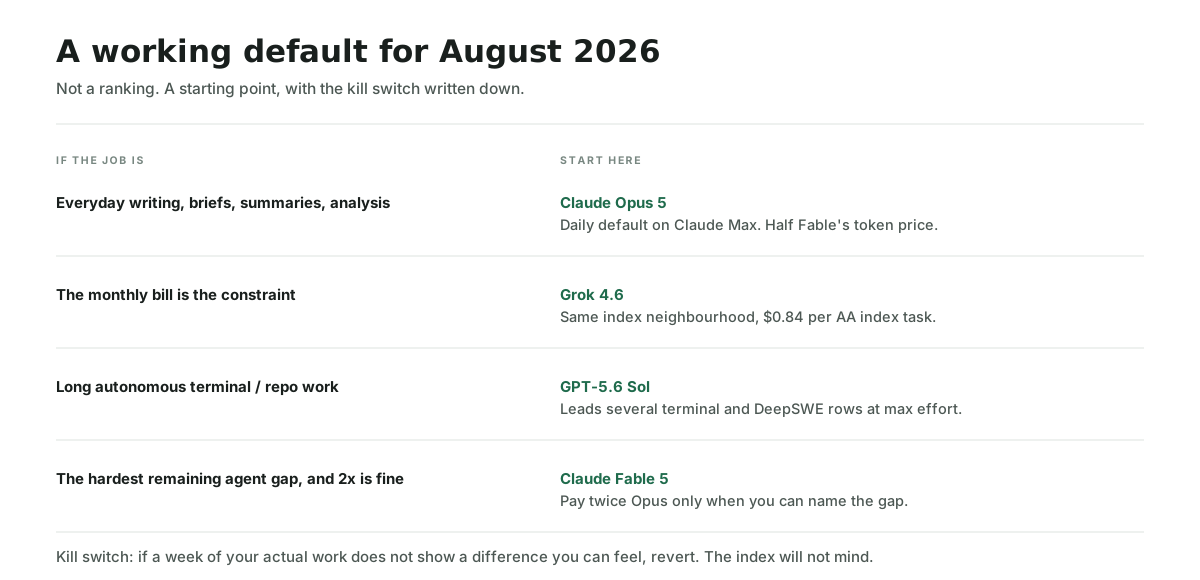
Everyday writing
High confidence
All three models I ran gave the same advice and usable prose. A regular user would not have picked the index leader from the page.
Hard reasoning
Low confidence
Public boards give Opus 5 a loud ARC-AGI-3 lead in Anthropic's telling. I did not reproduce it. Arithmetic, which I did run, was a three-way tie.
Coding agents
Medium confidence
Sol and Fable lead several terminal and DeepSWE rows. Opus 5 is close on CursorBench at half Fable's cost. The right pick depends on the harness.
Cost per task
High confidence
AA's index-task costs, the API rate cards, and my $312 example all point the same way. Grok is the cheap frontier option. Fable is twice Opus.
Speed
Low confidence
Reported first-token and Fast-mode gaps exist. I did not time the trial. Do not pick a default from a speed claim I did not measure.
Trust and brand risk
Medium confidence
Opus 5 and Sol are the boring procurement answers. Grok 4.6 may be fine internally and still fail a customer-facing review for reasons the Elo will not show.
- Average
- 3.5 / 5
- Binding constraint
- The job and the bill, not the two-point index gap. Everyday writing did not separate the three models I ran. Cost per task and the coding-agent boards did.
- Override applied
- None. Split is already the conservative reading of a 3.5 average.
A 3.5 average reads as a usable landscape. The binding constraint is why I would still not let the blend pick the tool.
Split for everyday knowledge work in August 2026.
As far as I can tell, the two-point index gap is not a reason to switch a team's default this week. Claude Opus 5 is the daily default I would hand a colleague who does not want to think about this. I expect it to stay there while it leads the independent index and costs half of Fable 5. Grok 4.6 is the model I would trial when the bill is the point, on the same three tasks, internally first. GPT-5.6 Sol is the model I would trial for long terminal and repo agents, because that is where the public rows keep handing it the lead. Claude Fable 5 is a 2x token premium. Pay it when you can point at a remaining gap. Do not pay it because the logo is heavier.
I would change this verdict if:
- A matched-rung independent board, dated after this piece, opens a gap on everyday writing large enough that a regular user notices it on three real files.
- Grok 4.6's cost-per-task advantage disappears once you count turns on the actual harness you use.
- Your own three-example test, not mine, cleanly prefers one model on the job you pay for.
Three of your own files beat my two
You can replay the recorded trial without an API key. You still need three of your own files if you want to choose a default, because my explainer and my token arithmetic are not your week.
git clone https://github.com/shravan1996/generative-ai-leaderboard-is-not-the-job
cd generative-ai-leaderboard-is-not-the-job
python3 -m unittest discover -s tests -t .
python3 eval.py
No network, no GPU, no third-party package. The full implementation is in the prototype repository.
- 01
Name one job you did last week
- Owner
- You
- Artifact
- One sentence: the task, the input, the output you needed
- Signal
- If you cannot name it, you are shopping, not choosing
- 02
Freeze three real examples
- Owner
- You
- Artifact
- Three anonymised prompts from actual work, not a toy
- Signal
- They should embarrass you slightly if they went wrong
- 03
Run two models on the same three, same day
- Owner
- You
- Artifact
- Side-by-side outputs, no editing before you score
- Signal
- A difference you can feel without a rubric
- 04
Price the month
- Owner
- You
- Artifact
- Last month's token volume at both rate cards, or the subscription you actually pay
- Signal
- A number large enough to care about, or not
- 05
Keep, split, or revert after a week
- Owner
- You
- Artifact
- A one-line default and a date to look again
- Signal
- If the week did not show a difference, the index does not get a vote
Before you change the team's default:
- The new default wins on your three examples, not on a screenshot
- The monthly bill at realistic volume is acceptable
- Anyone else on the team can find the same model without a private nickname
Revert if:
- A week of real work shows no difference you can feel
- The bill doubles because the "cheaper" model used more turns
- A customer-facing or regulated workflow fails a review the index never saw
For the next launch table
Three of your own files will tell you more than my two did. If the ranking flips on yours, tell me which rung each model ran at, and whether the arithmetic ever came back as anything other than $312. Mine never did, and I would not have bet on that.
Acknowledgements
This article builds on public boards and vendor posts. Digital Applied's 12 August fact-check of the Grok 4.6 launch table is the reason I trusted that table's cells and still refused its framing. Artificial Analysis, Anthropic, and VentureBeat are cited below for specific numbers.
References
Independent boards and fact-checks
- Grok 4.6 vs Sol vs Opus 5 vs Fable 5: Read the Tiers. Digital Applied, 12 August 2026. Rung mismatch, missing Opus 5 column, 31/31 cell check, AA index and cost-per-task figures.
- Opus 5: Fable 5 level intelligence at a lower cost per task. Artificial Analysis, 24 July 2026. Launch-week index, GDPval-AA, AA-Briefcase, cost per task, effort spread.
- Launching v4.1.1 of the Artificial Analysis Intelligence Index. Artificial Analysis, 6 August 2026. Index revision; Opus 5 still first at 63.
- Artificial Analysis Intelligence Index Leaderboard. BenchLM snapshot, 15 August 2026. Opus 5 63.0, Fable 5 62.1, Grok 4.6 60.9.
Vendor posts
- Introducing Claude Opus 5. Anthropic, 24 July 2026. Pricing, everyday-default positioning, CursorBench and Frontier-Bench claims, Fable 5 at twice the token price.
- SpaceXAI debuts Grok 4.6. VentureBeat, 12 August 2026. API rates, GDPval / CursorBench / DeepSWE / Terminal-Bench rows, cost-per-task and turn counts, procurement caveats.
This trial
- Source, prompts, recorded outputs, and evaluation
- Exact tested commit
- Same two prompts, 15 August 2026, on Grok 4.6 (high-fast), GPT-5.6 Sol (xhigh), and Claude Opus 5 (thinking-high). Fable 5 not run. Arithmetic target: 40 million input and 8 million output tokens at the headline Sol and Grok rates.
Sources last checked: 2026-08-15