
The second test I wrote for this prototype takes a clean context summary, adds 100 to one invoice amount, and hands both versions to the paper's verifier with the rollout horizon set to 50 steps. The test asserts that the two scores come out equal. It passes. I wrote it expecting it to pass, and it still bothered me to watch, because the verifier had just been shown a summary that will make the agent pay the wrong amount and file a wrong report, and it had nothing to say.
The verifier comes from an August paper by Guanghui Min, Liang Wu, Mayank Darbari, Chen Chen and Liangjie Hong, and the setting is one you operate whether or not you have thought about it. A long-running agent passes its context budget, a second model writes a summary of everything older than the last turn, and from then on the summary is the only record the agent has of what it already did. Coding harnesses do this, browser agents do this, and the OpenClaw compaction loop the paper adapts is the loop most of us copied. The paper's first contribution is to measure what the summary does to the agent's next few actions: right after a compaction the agent makes 0.108 more blocked calls per action, and a step later it starts repeating calls it has already made. The second contribution turns that into a score. Restore the environment at the boundary, roll the frozen agent a few steps from the raw history and a few steps from the summary, and charge the summary for the extra blocked or repeated calls it caused. The authors use the score to rewrite their compression prompt and report a 5.7-point accuracy gain and a 7.8-point gain in the share of tasks solved twice in a row.
I rebuilt the score with a scripted agent and a summariser whose mistakes I control, so that I could ask how much of a summary's damage ever makes the noise the score listens for. Restricted to damage the verifier can observe, choosing summaries by the score closed 93% of the gap between an unverified summary and an oracle that picks among the same candidates by finishing the task. Restricted to damage it cannot observe, a dropped identifier or a misremembered amount, it closed 16%. The paper's conclusion names silent state corruption as a limitation in one sentence. In my testbed that sentence was most of the result.
None of that reproduces the AppWorld numbers; there is no language model, no 4K context window and no API benchmark anywhere in my prototype. I did not evaluate the prompt-rewriting half of the method either, because I had no prompt to rewrite, and I cannot tell you whether an LLM compressor's mistakes split between the two channels the way my noise model's do. That last number is the one I most want and do not have, and I will keep coming back to it.
Ninety-three percent of one channel, sixteen of the other
Judge a context summary where it happens, by what the frozen agent does next from the same state, and the score you get is real: at a 48-token budget, picking the best of three summaries by it cut blocked calls by two thirds and moved accuracy from 42.7% to 44.6%. An end-of-task oracle choosing among the same three summaries reached 69.0%, because a dropped invoice id or a wrong amount never produces a blocked or repeated call, at any rollout length, and the score is a coin flip on exactly that damage. So wait on the score as a selector or optimiser until a fact check sits beside it, and adopt the paper's two diagnostics today: blocked and repeated calls in the steps after each compaction, and Pass², the share of tasks solved in both of two runs.
Twelve invoices, five ways to forget them
Take a back-office agent settling invoices. It lists the open invoices for a client group, fetches each amount, pays each one, and files a report with the total and the count. Every one of those is a tool call, and every call comes back with an observation that goes into the context. Twelve invoices is 27 steps on the shortest path. Somewhere along the way the context passes its budget and the harness does what Equation 1 in the paper describes: it keeps the most recent turn verbatim and replaces everything older with a summary.
What can the summary get wrong? Five things, in my task. It can lose an amount, lose the fact that an invoice was paid, lose the fact that the report was filed, lose an invoice id altogether, or remember an amount as a different number. Now watch what the agent does next under each one. Without the amount, it fetches it again. Without the paid marker, it pays again, and the environment refuses, because paying twice is an error. Without the filed marker, it files again and is refused. Those three leave a trace in the tool log that a script can count.
The other two leave nothing. An agent that never knew invoice 1108 existed does not ask about it. An agent that remembers 450 as 460 pays 460, and the payment tool accepts it, because nothing about a wrong amount looks wrong to a payment tool. Then the agent files a report with the wrong total. No rejected call, no repeated call. The task fails, and the failure is recorded nowhere until someone reads the report.
The paper is about the first kind of error, and it is precise about that. Its verifier counts "observable execution regressions", defined as actions the environment blocks and tool calls that repeat an earlier one. My whole contribution here is to ask how much of the damage is that kind, and in my testbed the answer was less than half.
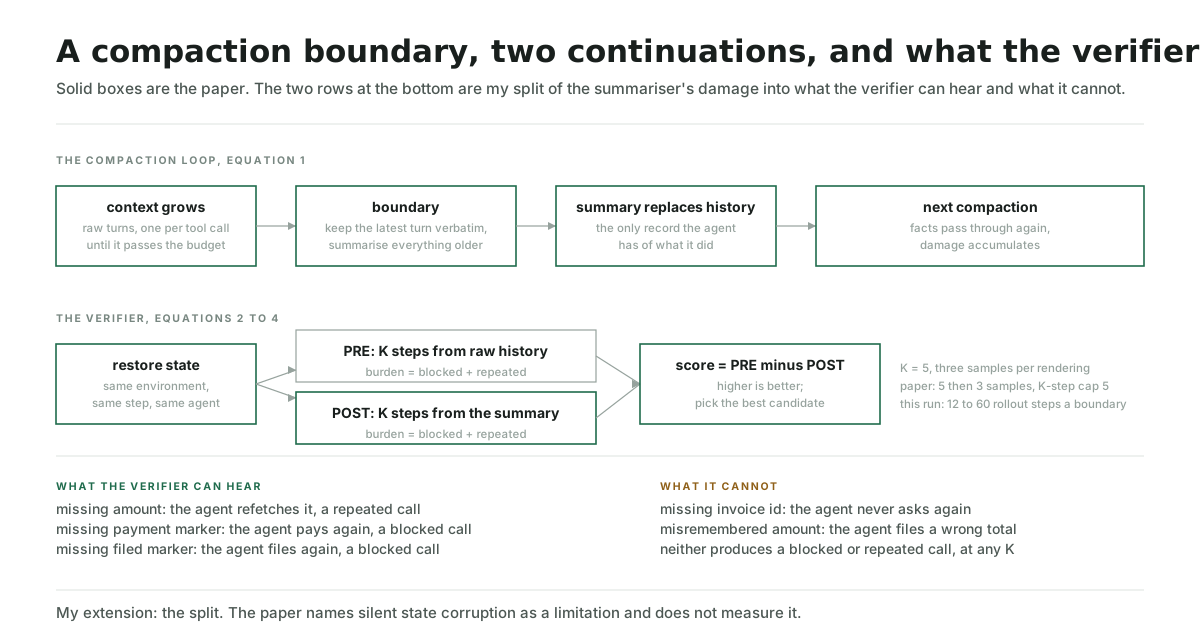
The bottom two rows of the figure are the experiment. Everything above them is the paper, and the paper's part deserves a proper reading before I start poking at it.
Blocked first, then refetching
The authors call the method TRACE, for Trajectory-Relative Agent Context ComprEssion, and it rests on a diagnosis I would send to a colleague even if the method did not exist.
Every summary is written from the last summary
The paper's first move is to insist that compaction is recurrent. Once the context exceeds the budget, the compressed replacement becomes the input both to the agent's next decisions and to the next compaction (Equation 1, Section 2.2). A fact that survives one summary has to survive the next one too. On AppWorld's 147-task train-development split with MiniMax-M3 as both agent and compressor, that shows up as pass rate falling with budget and falling fastest on tasks with the longest full-context horizons (Figure 1 in the paper).
One detail from that sweep surprised me, because it contradicts what I would have told you a month ago. Summarising does not beat plain FIFO truncation until the budget gets severe. At 16K, 8K and 4K, dropping the oldest turns matches or slightly beats the summary; only at 2K does the summary win, 72.8% against 42.2% (Section 3.1). AppWorld lets the agent re-query application state, so a dropped observation is recoverable, and what FIFO preserves that a summary does not is the shape of the last few actions. Hold onto that, because my prototype reproduced the ordering and I had not planned for it to.
Three probes at a frozen decision point
Section 3 holds the agent, the environment and the decision point fixed and asks what the summary changes.
At the last decision before termination, the summary-conditioned agent at 2K terminates in 44.6% of 10 sampled actions, with 37.3% in the required output form, against 77.2% and 68.1% for FIFO and 66.6% and 60.6% for the full history (Figure 2). The summary makes the agent keep working when it should stop. Across a summary's lifetime, the next-action distribution diverges from full-history behaviour by 0.149 when the recent raw turns are kept, 0.233 when they are compressed into the summary, and 0.289 when they are omitted (Figure 3), so compression keeps some of the effect of recent interactions and attenuates the rest. And in closed-loop continuation from 590 compaction boundaries, the summary produces 0.108 more blocked or error actions than the raw history at the first step, with repeated calls rising from 0.031 at step one to positive for the rest of a five-step horizon (Figure 4, 4,640 rollouts).
That third probe is the mechanism. The agent loses its place, hits an error, and goes back to reconstruct what it had.
Charge the summary for what the agent trips over
Given that, the verifier almost writes itself. At a boundary, take the context before replacement and the context after replacing the older history with a candidate summary, keeping the most recent raw turn. Restore the environment state, roll the frozen agent K steps from each, and mark each action that was blocked or repeated. The burden of a continuation is the count of marked actions over those K steps (Equation 2). The summary's induced burden is the expected POST burden minus the expected PRE burden (Equation 3), and its score is the negative of that (Equation 4). PRE is rolled once per boundary and shared across candidates, so candidates differ only in their own continuation.
def _continuation_burden(self, context, env, agent, rng, boundary) -> int:
    sim = env.snapshot()                              # restore the state at the boundary
    seen = {c.signature for c in sim.calls}           # every call made before the boundary
    ctx = list(context)
    burden = 0
    for _ in range(self.horizon):                     # K in equation 2
        if sim.finished:
            break
        action = agent.act(ctx)
        obs = sim.step(action)
        if obs.error or action.signature in seen:     # blocked, or repeated: the union, once
            burden += 1
        seen.add(action.signature)
        ctx.append(obs)
    return burden
Two tests pin the loop down. test_verifier_prefers_the_note_without_visible_damage builds two summaries from the same history, strips every payment marker from one, and asserts the verifier scores it worse. test_verifier_cannot_see_a_misremembered_amount is the one I opened with: add 100 to one amount in an otherwise clean summary and the two scores are equal at K = 50. Both pass, and the second one is the article.
The paper then uses those scores offline. At 12 stratified training boundaries it samples three candidate summaries each, keeps the best and worst by score, hands the 12 pairs and the agent's system prompt to a frozen proposer, gets five rewritten compression templates back, and picks the one with the highest Pass² on the development split (Section 4.2, Equations 5 to 10). The proposer never sees a rollout, an error message or the score decomposition. It sees which summary was preferred and nothing else.
Five points of accuracy, eight of repeatability
Reported
On AppWorld test-normal, 168 tasks at a 4,096-token compression window and a 50-step cap, the TRACE prompt reaches 77.1 accuracy, 67.3 Pass² and 86.9 Pass@2 averaged over two runs, against 71.4, 59.5 and 83.3 for the strongest existing compression baseline, the OpenClaw compaction prompt, and 85.7, 77.4 and 94.0 for no compression at all. On hard tasks it leads every compressed baseline on all three metrics: 63.5 against 60.3 accuracy, 52.4 against 47.6 Pass², with uncompressed at 75.4 (Table 1).
The Pass² gain is larger than the accuracy gain, which is the paper's whole thesis in one column: the optimised prompt makes success repeatable more than it makes success likely. The gap to uncompressed execution is still 8.6 accuracy points on average and 11.9 on hard tasks, so the method narrows the hole compaction digs without filling it.
A compressed prompt that beat no compression on Kimi
Reported
The template optimised with MiniMax-M3 was applied unchanged to Kimi-K2.7-Code as both agent and compressor. It scores 84.5 accuracy and 79.2 Pass², above that model's uncompressed 82.7 and 73.8, with Pass@2 slightly lower at 89.9 against 91.7. The strongest other compressed baseline on Kimi is at 46.1 accuracy (Table 2).
I read that table three times. A compression template beating no compression on the same model was the one result in the paper that genuinely surprised me, and the authors handle it carefully: on medium tasks the transferred prompt beats uncompressed on every metric, including a 20.8-point Pass² gain, while on hard tasks it stays below. My read is that a good summary is doing some of what a good scratchpad does, concentrating state the agent would otherwise have to find in a long raw context, and my guess is that this explains the medium-task gain better than the hard-task one. The paper offers the table as evidence of transfer and stops there, and with one target model it is right to stop.
Preliminary on every page
The paper's own probes make the behavioural diagnosis credible: the blocked-then-refetch pattern is measured on 590 boundaries with bootstrap intervals, and it is exactly the failure the verifier counts. What the paper does not have is an ablation of the method. There is no arm that optimises the prompt with a trajectory-level signal under the same proposer and selection procedure, so the comparison to ACON, which does use trajectory-level feedback, is confounded by everything else that differs between the two pipelines. Nor is there a version of TRACE with a different K, a different number of candidates, or the verifier replaced by a random preference.
Inferred
Take the 4,640 rollouts at 590 boundaries and a five-step cap as the cost of the diagnosis, and 12 boundaries times three candidates times roughly three to five samples as the cost of the optimisation. Call it 150 to 250 short rollouts plus five full development-split evaluations, each run twice. Against that the prompt is reusable and transferred once. The cost is dominated by selection, not scoring, and the selection is ordinary Pass² evaluation you would want anyway. My arithmetic, not the paper's.
The abstract says "preliminary" and every page says "work in progress", and I think the right response is to take that at face value and not score it as a finished result. Two runs per condition, one benchmark, one optimising model, one transfer target. No seeds reported, no intervals on Table 1. The twelve training boundaries are stratified by error type, which is sensible, and also means the prompt was tuned on exactly the failures the verifier can see.
Then there is the sentence I keep coming back to, from the conclusion: the verifier "may not capture silent state corruption." The paper offers no estimate of how much corruption is silent. A weekend prototype can get at that gap, so I built one.
| Evidence | What it supports | What it does not support |
|---|---|---|
| Paper Figure 4, 590 boundaries | Compaction raises blocked and repeated actions immediately and measurably | That those actions are most of the damage compaction does |
| Paper Table 1 | The verifier-tuned prompt beats every compressed baseline on one benchmark, two runs | A stable margin: no seeds, no intervals, no ablation of the signal |
| Paper Table 2 | One template transfers to one other model, and beats uncompressed on it | Transfer in general, or the mechanism behind beating uncompressed |
| Paper Section 3.1 | FIFO matches summarisation down to 4K when state is refetchable | The same ordering where observations cannot be re-queried |
| Paper Section 7 | The authors know the verifier is blind to silent corruption | Any measurement of how blind |
Four compaction papers I did not rebuild
Five candidates on agent context management from the last four months, screened on claim support, baseline strength, causal evidence, production transfer, and testability. One person, one afternoon, and a field that publishes a compaction paper a week, so read the list as a judgement about which mechanism I could isolate and not as a map of the area.
| Candidate | Gate | Decisive evidence |
|---|---|---|
| TRACE | Proceed; selected | The only one with a behavioural diagnosis of compaction damage measured at matched states, and a signal small enough to rebuild without a model. The self-declared limitation was a testable claim |
| ACM: Agentic Context Management | Proceed; not selected | Lossless by construction, offloading discarded context to memory the agent can query, with code and checkpoints. The mechanism under test is a post-training pipeline, and few readers can act on that this sprint |
| ARC: Addressable Recall Compaction | Proceed; not selected | Replaces old observations with ID-addressable citations. 99.40% against 88.12% on needle retrieval is a strong number, but the evaluation is retrieval, and execution is the property I wanted to test |
| VISTA | Proceed; not selected | Training-free and model-agnostic, with a dashboard the agent reads to decide what to archive. Gains are large and the ablation is real, but the mechanism is the agent's own judgement, which a scripted agent cannot stand in for |
| ACON | Outside the six-month window; baseline | October 2025, and the method TRACE is built against. Its trajectory-level feedback is the comparison, not the candidate |
TRACE won on one property. Its central claim is that a boundary-local, closed-loop signal captures compaction damage, and you can falsify that by building a summariser whose damage you control and asking what fraction of it the signal sees.
Three predictions, one of them badly wrong
The question
When a summary is scored by the extra blocked or repeated calls it causes over the next K steps, how much of the task success that compaction lost does choosing by that score recover, and what kind of damage does it leave behind?
- Baseline
- The same lossy summariser with no selection: one summary per boundary, taken as written.
- Continue if
- The verifier recovers at least half the accuracy gap between the unverified summary and an end-of-task oracle choosing among the same candidates, with a reduction in blocked and repeated calls to show the signal is real.
- Stop if
- Under a quarter of the gap recovered, or no reduction in blocked and repeated calls, which would mean the signal is noise in this testbed.
Before the run I wrote down three predictions. The verifier would cut blocked and repeated calls substantially, because that is literally what it selects against. It would recover most of the task success the summary lost; I guessed two thirds of the gap to the oracle. And a longer rollout horizon would catch more, because silent damage would eventually turn into a wrong report, which the environment could reject.
The first held. On the second I was wrong by a wide margin. On the third I had assumed something the task design plainly contradicts, and seeing why is the most useful thing in this article.
A scripted agent that settles invoices
One task family, synthetic and written for this article: settle every open invoice for a client group and file a report with the total and the count. Three to twelve invoices per task, so the shortest correct trajectory is 9 to 27 steps against a cap of 50. 120 tasks, four runs each, which gives two disjoint run pairs for Pass² and Pass@2.
The environment has five tools and an execution-error contract. Paying an invoice that is already paid is a blocked call; so is filing twice. The environment is copyable, so a verifier can restore the exact state at a boundary and roll forward from it as many times as it likes.
The agent is a script. It reads everything it believes from its context and nothing else, re-reads an invoice it already knows 5% of the time to give the repeat detector something to detect, and works in a shuffled order per run. No language model anywhere.
The compaction loop is Equation 1: when the context passes the budget, keep the latest turn verbatim and replace everything older. Budgets are 24, 48 and 96 tokens against raw trajectories that reach 105, roughly the compression ratios the paper runs at 2K to 8K. Four policies replace the older turns:
| Policy | What replaces the older turns | Extra rollouts |
|---|---|---|
fifo | nothing; the oldest turns are dropped | none |
summary | one structured note from a lossy summariser | none |
trace | the best of three notes by the paper's paired-continuation burden, K = 5, three samples per rendering | boundary-local |
oracle | the best of the same three notes, by rolling each to the end of the task and taking the one that finishes fastest | trajectory-level |
A summariser that forgets at a rate I chose
The summariser is where the damage comes from, and it is the part I would ask you to read most suspiciously. Every time a fact passes through it, it forgets or corrupts that fact at a fixed rate, independently. The mixed default is 10% for each of the three visible defects, a dropped amount, a dropped paid marker and a dropped filed marker, and 5% for each of the two silent ones, a dropped invoice id and a misremembered amount. Damage compounds across compactions because the next summary is written from the last one. Those rates are chosen, not measured, which is why the experiment that matters most is the one where I vary them.
git clone https://github.com/shravan1996/ship-the-paper-context-compaction
cd ship-the-paper-context-compaction
python3 -m unittest discover -s tests -t .   # 20 tests
python3 eval.py                              # 120 tasks, 4 runs, ~13 seconds, writes results.json
Python 3.14 on an arm64 Mac. No network, no model, no GPU, no third-party package. The run is deterministic given the seeds, and one of the tests asserts that, which I mention because it did not pass the first time. The summariser iterated over a Python set of paid invoices, set order varies with the hash seed, and so two runs of the same episode chose different candidates at the same boundary. One sorted() fixed it. A verifier that ranks three near-identical summaries is exactly the kind of code where a nondeterminism bug looks like a finding, and I would not trust any of the numbers below if that test were not in the suite.
Two thirds of the blocked calls gone, two points of accuracy back
Budget 48, 120 tasks, four runs each. Blocked and repeated are per run.
| Policy | Accuracy | Pass² | Pass@2 | Blocked | Repeated | Rollout steps per run |
|---|---|---|---|---|---|---|
| no compression | 100.0% | 100.0% | 100.0% | 0.00 | 0.86 | 0 |
fifo | 35.6% | 32.5% | 38.8% | 0.00 | 0.76 | 0 |
summary | 42.7% | 32.1% | 53.3% | 0.67 | 2.80 | 0 |
trace | 44.6% | 34.2% | 55.0% | 0.22 | 1.40 | 85.0 |
oracle | 69.0% | 57.5% | 80.4% | 0.74 | 3.29 | 51.0 |
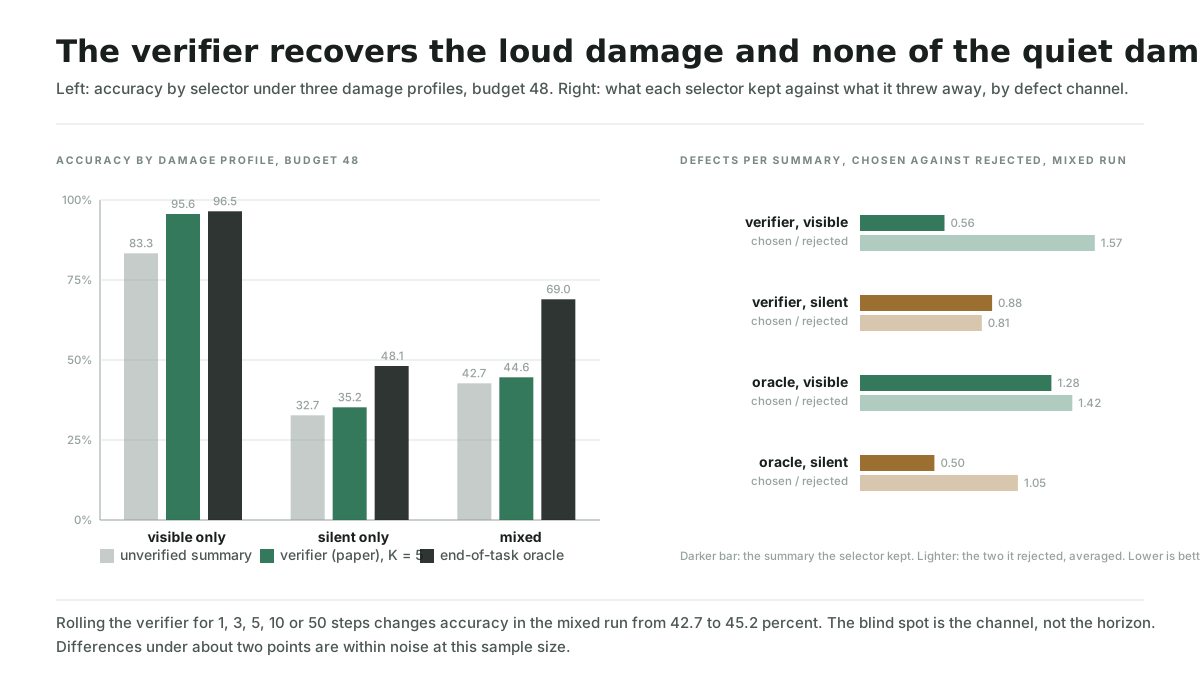
Reproduced
Selecting by paired-continuation burden cut blocked calls per run from 0.665 to 0.219 and repeated calls from 2.80 to 1.40, and chose summaries carrying 0.56 visible defects each against 1.57 for the ones it rejected. Accuracy moved from 42.7% to 44.6% and Pass² from 32.1% to 34.2%. Choosing among the same three summaries by rolling each to the end of the task reached 69.0% and 57.5%. Rolling the verifier for 1, 3, 5, 10 or 50 steps instead of 5 gave 42.7%, 42.9%, 44.6%, 45.4% and 45.2%, at 21.5 to 158.7 rollout steps per run.
Reproduced
With the summariser restricted to visible defects only, the verifier took accuracy from 83.3% to 95.6% and Pass² from 79.6% to 92.9%, against 96.5% and 93.8% for the oracle. Restricted to silent defects only, it moved accuracy from 32.7% to 35.2% against 48.1% for the oracle, and chose summaries with 1.59 silent defects each against 1.61 for the ones it rejected.
Inferred
The stop threshold did not fire, because the signal is plainly real: two thirds of the blocked calls gone, half the repeats gone, and a clean preference for summaries with less visible damage. The continue threshold did not fire either. The verifier recovered 1.9 of the 26.3 points between the unverified summary and the oracle, which is 7%, against the 50% I had asked for. Read by channel, it recovered 93% of the visible-only gap and 16% of the silent-only gap. My read is that the verifier is not weak. It is complete on one channel and absent on the other, and in the mixed regime the other channel carried the task.
So did the verifier work? On the channel it can hear, almost completely; on the other, not at all, and the four sections that follow are what those numbers changed about how I would use it. Only the first was on my list.
Why not just watch longer?
Because the damage never becomes an event. My third prediction assumed a dropped invoice id would eventually show up as a blocked call, if you only watched long enough. It never does. The agent files a report with fewer invoices than exist, and the environment accepts the report, because a report is not a duplicate write. The only thing that could reject it is a check against ground truth, which the verifier does not have and the paper does not claim. Going from K = 5 to K = 50 costs 1.9× the rollout steps and buys 0.6 points, within noise. I expect the same holds for any environment whose tools accept a wrong value without complaint. The blind spot is the channel, and watching longer does not change which channel you are listening to.
The filter keeps the summaries it cannot hear
In the mixed run, the summaries the verifier chose carried slightly more silent defects than the ones it rejected, 0.88 against 0.81, and 61.1% of chosen summaries had at least one against 58.0% of rejected. The effect is small and I would not promise it reproduces. I suspect the direction is the one to watch for in a real system: a selector that removes everything it can see leaves you with a population of summaries that are wrong in exactly the ways nothing downstream will flag. The oracle, which can see outcomes, went the other way, with 0.50 silent defects chosen against 1.05 rejected.
FIFO fails the same way every time
FIFO's gap between Pass@2 and Pass² at budget 48 is 6.3 points; the summary's is 21.2. By the paper's measure that makes FIFO the more reliable policy, and it is, in the narrow sense that it fails identically on every run: it drops the invoice list, the agent never learns it is missing invoices, and it files a short report with zero blocked calls. At the loosest budget FIFO beat the summary outright, 90.8% against 85.4%, which is the paper's ordering at 4K and above. I had not predicted that, and I was less surprised by the direction than by the size of the margin. My summariser is lossy at a fixed rate however little it is compressing, which an LLM summarising a short context probably is not, so I read that as a fact about my testbed. The Pass² lesson does generalise, though: a low gap can mean stable success or stable failure, and the metric cannot tell you which.
Eighty-five rollout steps against fifty-one
The cheap verifier was not cheap here: 85 rollout steps per run against 51 for the oracle. My tasks are at most 27 steps long, so running to the end is inexpensive, and the verifier pays for three samples of two continuations per candidate at every boundary. The paper's cost case is about 50-step tasks with a language model in the loop and a verifier run at twelve boundaries, once. Nothing in my prototype tests that, and I would expect the ratio to flip in the paper's setting. What I would not expect is for online selection at every boundary, which is how I used it, to be cheap anywhere.
Unknown
Whether an LLM compressor's mistakes split between visible and silent damage at anything like a 60/40 ratio, or 90/10, or 10/90. Whether a more suspicious agent, one that re-lists invoices when something feels off, would convert silent defects into repeated calls at an acceptable cost in steps. Whether the paper's prompt-rewriting stage, which my prototype does not have, learns rules that incidentally reduce silent corruption, because the proposer reads the summaries themselves and might notice a missing id where the verifier cannot.
Where your summaries carry more than mine
Branch names, file paths, and which of three records the user meant
My task has two silent defects and three visible ones. A real agent's summary carries user preferences, file paths, branch names, the reason a previous approach was abandoned, which of three similar records the user meant. Almost none of those produce an error when they are wrong; the agent proceeds, confidently, on the wrong one. The paper's AppWorld setting is friendlier than that, because application state can be re-queried and bad API calls are rejected by contract. If your tools accept whatever they are given, the verifier has less to hear. The control is to enumerate, before you deploy the score, which facts in your summary schema would be rejected if wrong and which would be accepted, and to count the second list.
A falling error rate beside a rising wrong-output rate
Any filter shapes the population it passes. Filter on visible burden and the summaries that remain are those whose damage is silent, which is what the mixed-regime selection numbers hint at. The warning sign is a falling blocked-and-repeated rate alongside a flat or rising wrong-output rate. The control is to track both, and to treat a divergence between them as a signal that the filter is working and the task is not.
An agent that will not stop
The paper's Figure 2 is the finding I would least like to have in production: at 2K the summary-conditioned agent terminates correctly 37.3% of the time against 60.6% on full history. An agent that does not stop keeps calling tools, and in a system with side effects that goes beyond a quality problem. The verifier catches some of it, because extra calls after completion are often repeats. The control is independent: refuse to let the agent finish without the terminal output form, and alarm when a run exceeds its full-context reference length by a margin.
A prompt tuned on the failures the verifier can see
The twelve training boundaries were chosen because they exhibited blocked actions, stratified by error type. The proposer then learned rules from summary pairs at those boundaries. I would expect the resulting template to be good at preserving whatever makes blocked calls go away and to have no particular pressure toward preserving identifiers the agent never acts on. The transferred template beating uncompressed execution on Kimi suggests the rules are general enough to help anyway. I would still regress any prompt change against a fact check before shipping it, because the optimiser's signal was not built to catch the regression I am most worried about.
Ten compactions per episode, and no selector can help
At a 24-token budget my summary policy ran 10.6 compactions per episode against 2.0 at 48, and accuracy fell to 12.9% with the verifier at 14.2% and even the oracle at 35.4%. Every fact was passing through the summariser five times, and no selector can pick a good summary out of three bad ones. The paper sees the same cliff between 4K and 2K. The control is a floor: never compact to a budget the summary schema itself cannot comfortably fit in, and alarm on compactions per task, not on context size.
Three rows at 4 or 5, two at 2, one reason
The scores cover the verifier as a signal: the paired-continuation burden score, used either to select summaries online or to tune a compression prompt offline, plus the two diagnostics the paper builds it from. The prompt optimiser itself is scored only where the paper gives evidence.
Response time / throughput
Medium confidence
Online selection costs 2K agent steps per candidate per sample at every boundary, with the environment restored each time. My prototype spent more rollout steps than an end-of-task oracle. Offline, at a dozen boundaries, it is a one-time cost.
Cost
Medium confidence
Offline use is cheap and the prompt is reusable and transferred once in the paper. Online use multiplies inference by the candidate count and the sample count, and my prototype gives no reason to think that buys accuracy.
Data gravity
High confidence
No labels, no training data. The signal comes from the environment the agent already runs in.
Evalability
High confidence
Blocked rate, repeat rate and Pass² are directly computable and the paper's code is public. Not higher: the signal is blind to a channel of failure by construction, and the prototype measured that blindness at a coin flip on silent damage.
Failure modes
Medium confidence
A selector that removes visible damage leaves a population of summaries that are wrong in unflagged ways, and my mixed-regime selection numbers lean slightly that way. The wrong-output failure is the expensive one and the score cannot see it.
Integration
Medium confidence
Needs a restorable environment, which sandboxes and replayable API mocks provide and live systems with side effects do not. Otherwise it is a loop around code most harnesses already have.
Compliance / audit
Low confidence
A score per boundary is a good audit record of why a summary was chosen. It is also a record that says nothing about the omissions that matter most to an auditor, such as a dropped identifier.
Operations burden
Medium confidence
Requires a restorable state, a canonical call signature, and a Pass² evaluation loop. Reasonable to run. The burden is in maintaining the fact check beside it, which is not part of the paper.
- Average
- 3.1 / 5
- Binding constraint
- Observability. The score hears blocked and repeated calls and nothing else, and in the only experiment that measured the split, the unheard channel decided the task.
- Override applied
- None from the rubric. Evalability at 3 rather than 2 is what keeps Wait rather than Never on the table, and it rests on the fact check being cheap to add.
A 3.1 average reads as a routine Wait, and the average hides how unequal the rows are. Three of them are 4 or 5 because the signal is free, label-less and easy to wire in. Two are 2 because of one fact: it is deaf to the failures I would most want it to hear. If you could score only one row, score Failure modes, and ask whether your summary schema carries facts whose corruption produces no error. Mine did. I expect yours does too.
Check the summary while the history still exists
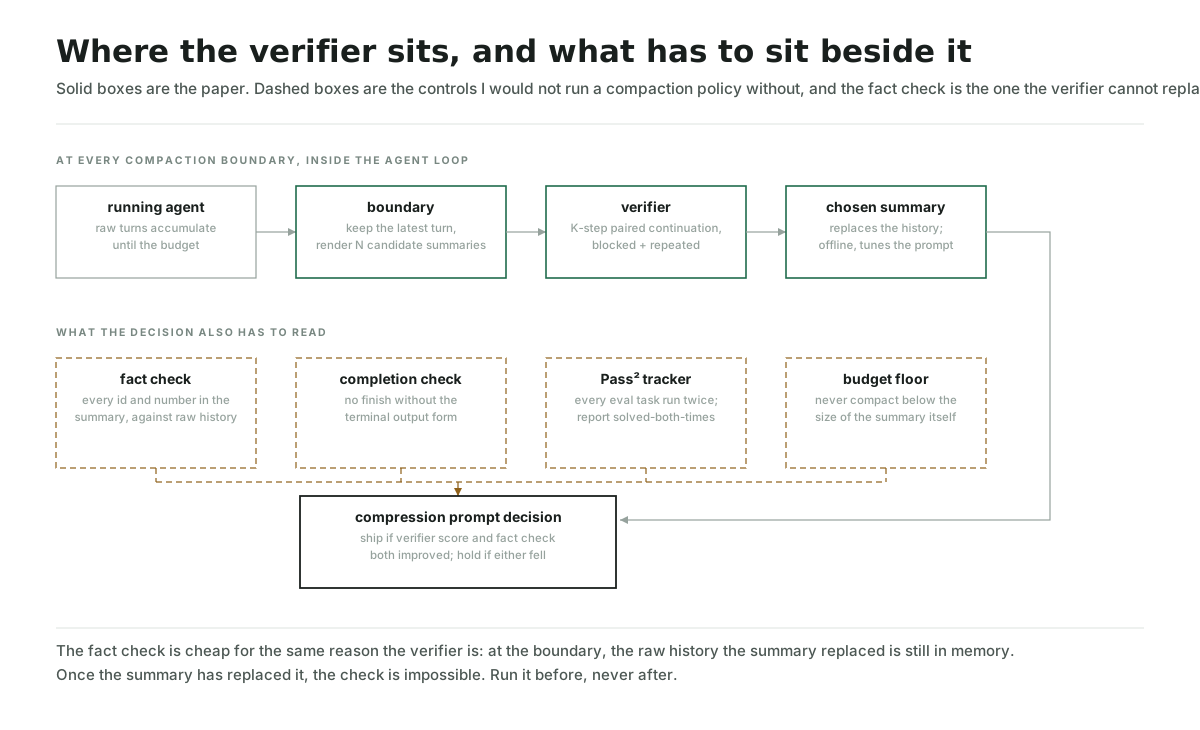
Read the figure as one boundary. The context passes the budget, the summariser renders its candidates, and at this exact moment the raw history those candidates are about to replace is still in memory. Run the verifier here if you can restore state, and run the fact check here whether you can or not: every identifier, amount, path and marker in the chosen summary, looked up in the raw turns it summarises. A missing invoice id is a one-line set difference. A misremembered amount is a one-line comparison. The check is cheap for the same reason the verifier is, and unlike the verifier it hears the quiet channel. Once the summary has replaced the history, the check is impossible, so it runs before and never after.
The completion check and the budget floor sit on the agent loop and need nothing from the paper. The Pass² tracker sits on your evaluation job and is the paper's best idea about measurement: run every task twice and report the fraction solved both times, beside the fraction solved at all.
The decision at the bottom is what I would hold the line on. A new compression prompt ships when the verifier score and the fact check both improved on the development set. It holds when either moved the wrong way, and the case I am most worried about is the one where the verifier improved and the fact check got worse, because that is what a prompt tuned on visible failures might do.
Enumerate the silent channel before you tune anything
- 01
Enumerate the silent channel
- Owner
- Applied science
- Artifact
- A two-column list of every fact your summary schema carries: facts whose corruption triggers a tool error or a repeat, and facts that would be accepted wrong
- Signal
- The second column exists and someone has counted it
- 02
Instrument the paper's diagnostics
- Owner
- Platform
- Artifact
- Blocked rate and repeat rate per action in the five steps after each compaction, and compactions per task, on the existing agent with no other change
- Signal
- A post-compaction spike like the paper's Figure 4 is visible or provably absent on your traffic
- 03
Freeze a replayable evaluation set
- Owner
- Applied science
- Artifact
- At least 100 tasks with restorable environment state, run twice each, reporting accuracy, Pass² and Pass@2
- Signal
- The Pass@2 minus Pass² gap is known for the current compressor
- 04
Add the fact check at the boundary
- Owner
- Platform
- Artifact
- A check that every identifier and number in the chosen summary appears in the raw history it replaced, logged per compaction
- Signal
- Silent defect rate per compaction, reported separately from the verifier score
- 05
Tune the prompt offline with both signals
- Owner
- Applied science
- Artifact
- A TRACE-style preference set from a dozen boundaries, candidate templates, and a decision record showing verifier score and fact-check rate before and after
- Signal
- Both improved on the development set, or the change is held
- 06
Shadow, then decide
- Owner
- Engineering leadership
- Artifact
- Four weeks of the new prompt in shadow against the incumbent on the same traffic, with a decision record naming the metric that made the call
- Signal
- Wrong-output rate did not rise while blocked and repeat rates fell
Before a new compressor ships, four things have to be true on the frozen set. Its silent defect rate per compaction, measured by the fact check, is at or below the incumbent's. Pass² improves by more than the run-to-run noise, measured over at least two disjoint run pairs. Post-compaction blocked and repeat rates fall while the wrong-output rate does not rise, on the same runs. And compactions per task stay under a fixed ceiling, with no compaction running below the budget floor.
Any one of the following sends it back. The fact check finds a dropped identifier or altered number in more than 2% of chosen summaries in shadow. Blocked and repeat rates fall while the wrong-output rate rises for two consecutive weeks, which means the filter is selecting for silent damage. Runs exceed their full-context reference length by more than 50% after a compaction, or fail to produce the terminal output form. Or any compaction runs on a workflow with irreversible side effects where the environment cannot be restored, because the verifier's rollouts would then execute real actions.
Every compression-prompt change is reviewed by someone who has seen the verifier score and the fact-check rate side by side, before and after. Review of individual summaries is not required. Review becomes mandatory on any workflow where the fact check cannot be run, because on that workflow nothing is watching the silent channel.
Wait on the selector, ship the diagnostics
Wait for any workflow whose summaries carry identifiers or values the agent does not re-read. Ship the diagnostics now.
The verifier is a good idea and I would like to have it. It measures a real effect at the moment the effect happens, with no labels, and in my prototype it did exactly what it promises: two thirds of blocked calls gone, half the repeats gone, a clean preference for summaries with less of the damage it can see. The paper's behavioural probes are the best description of compaction failure I have read, and the Pass² measure is one I have already started using.
What stops me is the part the verifier is built not to hear. I had assumed silent corruption was a corner case the authors flagged for completeness. In my testbed it was the main event, which surprised me more than any number in the paper did, and nothing about rollout length, candidate count or sample count changes it, because the damage never produces an event the environment can reject. Where the paper and my prototype disagree on emphasis, I trust the paper on how well the score works on AppWorld and the prototype on what the score can and cannot observe, because those are the questions each one measured. Neither of us knows how an LLM compressor's errors split between the channels, and that number decides everything.
The narrow path I would take today is the architecture above: the verifier offline, tuning the prompt, with a fact check beside it that has veto power. I would not let the score choose summaries online, where my prototype found it more expensive than an oracle and barely better than no selection. And I would not let a falling blocked-call rate stand in for task success on any dashboard, because the two came apart by 24 points in the run where it mattered.
I would change this verdict if:
- Someone measures the visible-to-silent split of a real LLM compressor's defects on a real agent and finds silent damage under a fifth of the total. Then the verifier is most of the answer and the fact check is a backstop.
- The prompt optimiser is shown to reduce silent corruption as a side effect, by a fact check run before and after on the paper's own AppWorld boundaries. The proposer reads the summaries, so it might.
- A boundary-local signal is found that hears the silent channel, such as a short continuation scored against the raw history's outputs instead of its errors. Then the paper's framework carries it with no change to the loop.
Notes I pinned above the compaction loop
The number I most want is the one nobody has published: take a real agent's real compaction summaries, diff every entity and number in them against the raw history, and count how many of the defects would have made a noise. If you have that log, or a harness that could produce it in an afternoon, I would like to compare notes, because my 60/40 split is a parameter I typed in and the whole verdict leans on it.
Acknowledgements
This article builds on Toward Reliable Context Compression for Long-Horizon Agents: An Empirical Study of Execution Instability by Guanghui Min, Liang Wu, Mayank Darbari, Chen Chen, and Liangjie Hong. The compaction loop, the execution-burden metric, the paired-continuation verifier and the Pass² framing are theirs, and their code is at nokia-applied-research/Trace. Errors in my reading of them are mine.
The prototype is an original implementation. It does not use the authors' code, models, tasks or data, and it reproduces none of their results. It is Python standard library only, under MIT. The invoice tasks are synthetic and were written for this article.
References
Primary research
- Toward Reliable Context Compression for Long-Horizon Agents: An Empirical Study of Execution Instability. Guanghui Min, Liang Wu, Mayank Darbari, Chen Chen, Liangjie Hong, 2026 (arXiv:2608.06503, submitted 6 August 2026). TRACE is Trajectory-Relative Agent Context ComprEssion
Supporting and contrary evidence
- ACON: Optimizing Context Compression for Long-horizon LLM Agents. Minki Kang et al., ICML 2026. The trajectory-level prompt optimiser TRACE is built against
- ACM: Agentic Context Management for Long Horizon Tasks. Xiaochuan Li et al., 26 July 2026. Lossless context management by offloading to queryable memory
- Addressable Recall Compaction for Long Context-Window Control in AI Agents. Thang Dang et al., 27 July 2026. Replacing old observations with addressable citations
- LLM Agents Are Latent Context Managers: Eliciting Self-Managed Context via State Proprioception. Binyan Xu, Haitao Li, Kehuan Zhang, 29 June 2026. A training-free dashboard the agent reads to decide what to archive
- AppWorld: A Controllable World of Apps and People for Benchmarking Interactive Coding Agents. Harsh Trivedi et al., ACL 2024. The benchmark and the execution-error contract the verifier counts against
Prototype
Sources last checked: 2026-08-23